
Finding Connection Beyond the Screen
Imagine having to go 2 weeks without your phone or an alarm. Flying 13 hours across the world with 16 people you barely know, leaving behind the comfort of your digital bubble in order to serve, build, paint, teach, and completely immerse yourself in a culture halfway across the globe. Sounds kind of crazy, doesn’t it? Most people wouldn’t even consider an experience like this and end up packing a charger as a lifeline, but we went to Cambodia looking for something else. We were signing up for a challenge that required us to be fully present, not just in body, but in mind too. We gladly stripped away our digital safety nets to trade convenience for genuine human connection, as we entered into an experience that would change our lives.

Without the digital shield of a smartphone, every emotion hits a little differently. Every thought gets louder, every action gets bigger. Without the ability to retreat and hide into a screen, I couldn’t just observe life, I had to inhabit it. The heat, the humidity, the dirt, and the red dust on our shoes - it all became a part of our story. When the truth felt heavy, like hearing the stories of the Khmer Rouge or witnessing the weight of history, I couldn’t just swipe away the discomfort, sadness, and pain I felt for the community. I sat in silence, choosing to respect it, and learn about it. When moments felt joyful, like seeing a local student’s face light up as they danced, played games, learned from, and talked with us, the happiness didn’t get lost or discarded behind a notification on a screen. The emotions stayed with me and allowed me to see the world as it truly is.

Real connection doesn't happen through Wi-Fi; it happens through shared sweat, paint, and presence. Take our group at the airport, for example. We began as a quiet collection of strangers from different schools and backgrounds. As we waited for our flight, we made the conscious decision to put our phones away and not use them as something to hide behind. Usually, that time is spent in a digital bubble, heads down, scrolling until boarding. Instead, I pulled out a hacky sack, and suddenly, the terminal floor became our playground and everyone wanted to join in. There was no screen to distract us, so we just played. We laughed, we missed, we cheered, and by the time we boarded, those “kids I don’t really know” were already becoming my team and my friends. It was a small, silly moment, but it taught me that connection doesn't need a signal, it just needs an opening.
That openness continued at our hotel in Pursat, Cambodia with our late-night talks and games, unfiltered and undistracted, that have turned strangers into family. Despite the nagging reminder in our minds that we’d have to get up early the next morning, this became a nightly routine for us because we loved connecting with each other. It’s incredible how simply setting aside our devices allows us to strip away the barriers and build a genuine sense of unity with each other.

People might wonder what challenges we faced in regards to the language barrier, and how you connect to someone without having a google translator in your back pocket. We built that connection through our body language, expressions, dancing, playing games, and more. We communicated through words sparingly. The kids learned some English in school, and we were happy to help practice it with many of them (and they taught us a little Khmer in return!). The experience with communication that challenged me the most was during my education lesson when I taught the line dance “Boot Scootin Boogie”. I found that as long as I took my time, going slow enough for the teacher to translate what I wanted the kids to do, the language barrier didn’t have to be a setback. It also helped to use easy words that the students understood and body movements that they could follow along with until they had the steps down. This experience showed me that even when words fail, there are countless other ways to connect, learn, and understand one another.
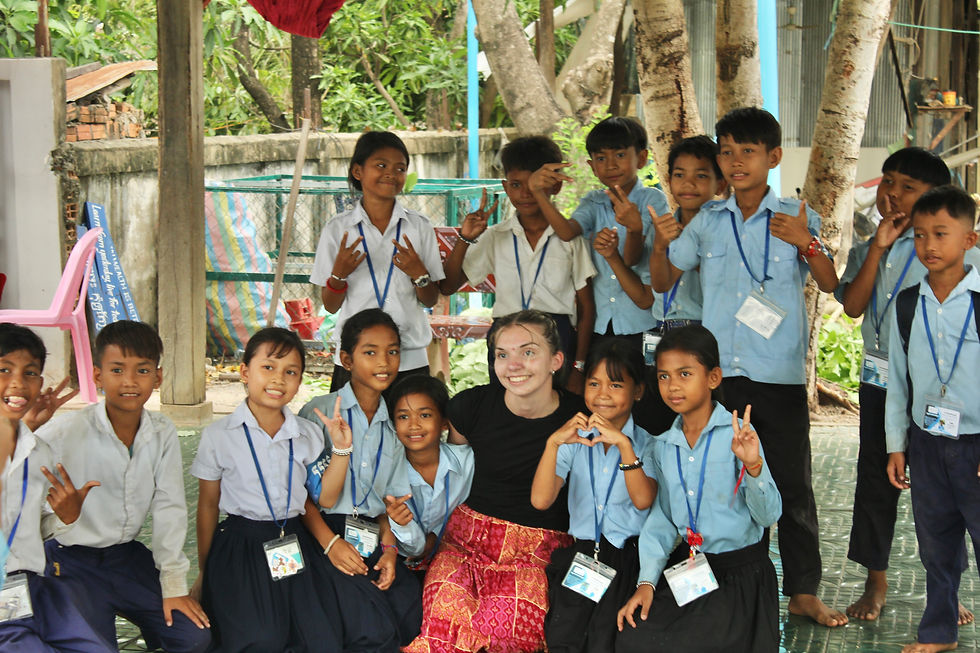
Looking back, I realize that leaving my phone behind wasn’t really about giving something up; it was about making room for something more meaningful. Without my phone, I was able to be fully present in every moment, whether that meant sitting with the difficult emotions that came from learning about Cambodia, overthinking, laughing with my new friends late at night, or connecting with students even when we didn’t speak the same language. I learned that the things we see as barriers don’t always stop us from connecting. Without Google Translate, we found ways to communicate through dance, games, expressions, and simply being willing to understand one another. Without a screen to hide behind, I was pushed to step outside of my comfort zone and open myself up to people I barely knew. I went to Cambodia thinking I was giving up my phone for two weeks, but I came home realizing I had gained something much more valuable: a deeper appreciation for being present, a stronger ability to connect with others, and a reminder that the most meaningful moments in life don’t need Wi-Fi.


Comments