
The Path to Humanhood
Editor’s Note
At Youthlinc, we believe that the most meaningful way to understand our world is through the lived experiences of others.
The following reflection is written by a member of our Real Life team, who works closely with refugee and immigrant youth here in Utah. Real Life exists to support students as they navigate education, identity, and belonging-often while carrying stories that are complex, painful, and deeply human.
We share this piece because it reflects the heart of our mission: to create lifetime humanitarians by fostering understanding across cultures, experiences, and identities. Stories like this invite us to listen more closely, see more clearly, and recognize the shared humanity that connects us all.
We’re grateful to Hay Soe for trusting us with his story.
The Path to Humanhood
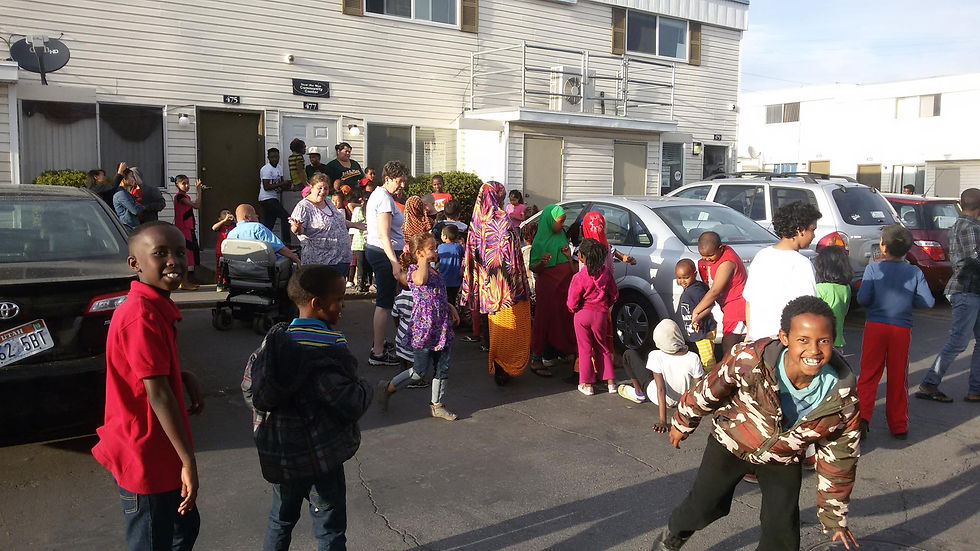
When I visit Real Life sites I occasionally pass by what used to be the South Parc Townhomes and all the memories come flooding back. I remember when my family was first resettled, I’d play soccer with my friends right outside the apartment complex. When our African friends beat us, they’d say, “Go back to China!” When we beat them, we’d tell them, “Go back to Africa!” It was to establish territory after winning, I guess. We were friends and we’d laugh about it with each other. We didn’t say those things out of malice or hate, but we were ignorant. They thought China comprised all of Asia. We thought Africa was one big country where they all spoke the same language.
We moved to the South Parc Townhomes because the run-down complex was one of the few affordable options for newly resettled refugees. During that time, I discovered that Africa was a continent and that there were many languages, cultures, and cuisines. I learned that Ethiopians are different from Somalians and Congolese. Meanwhile, my African friends learned that Karen (pronounced kuh-REN) are different than Nepali, which are different than Chinese. It became apparent that although we were all labeled “refugee”, our stories were different. Not greater, not worse; just different.
I will never fully know the stories of my friends and how their families became refugees, but I know the story of the Karen people and how we became refugees. The Karen are an ethnic group indigenous to southeastern Myanmar (Burma). To be born Karen in Myanmar is not fair. From the moment of birth, you are considered the lesser kind. Your culture, your language, and your humanity are all viewed as inferior. Your blood must be mixed with someone who is Burmese to have equal status as a human. Since the early 1940’s, the Burmese Military Junta have used these beliefs of superiority to justify the ethnic cleansing on indigenous ethnic minorities in Myanmar.
Constant fear and desperation capture the Karen experience in Myanmar. At any moment, your village may be under attack and burned to the ground. Your children may be killed and tortured, your wife raped and mutilated, and your husband beaten and enslaved in front of your eyes. If you survive the inhumanity, you will be used as a porter and a human shield. If you are lucky enough to escape the whole massacre, you join others whose village endured the same. You become internally displaced. Many die in the jungle of malaria, flu, cold, and other sicknesses. You are starved and sleep deprived. To flee, you have to travel miles through the mountainous regions. The fortunate few who make it to the refugee camps along the Thai-Burma border have the chance to live.
My family endured that fate. My parents’ villages were burnt to the ground, and my family had to run for their lives in the jungle. We were the lucky ones. We made it to Mae La Refugee Camp. We were given a little piece of land, and a monthly ration from the UN, which included some rice, beans, and fish paste. Though the refugee camps were better than the situations back in Myanmar, the conditions were hardly adequate. In Mae La, 1 in 3 people suffer from PTSD and 1 in 5 attempt to take their own lives. The camp is surrounded by barbed wires and there is little opportunity and access to education. You are trapped. Those who sneak out of the camp to get food or bamboo are severely punished by the guards. On the road that runs adjacent to the camp, if you are hit by a car, they toss you to the side of the road as they would do an animal because you are less than human.

Getting resettled was a chance for a better life. A chance to be human. The process was long and intensive and included years of screening. We began by getting our household refugee documents in order and waiting for them to be verified. Once verified, we started the applications to be resettled. My family went through multiple rounds of interviews that included long waiting periods in between, and we were fortunate to be selected. Many other families would not be chosen and would have to start the process all over again.
When my family received word that we would be resettled, we were required to go through specific training for the country we had been accepted to. Since we were coming to America, they taught us about the dollar bills, coins and their values, and how the middle finger gesture was bad. The final training was what we called “airplane education.” This training included all that you would teach someone who has never been on a plane and at the time, my family had never even seen a plane before. The whole process took more than two years, but now we’d have a chance to start a new life. A chance to be human.

However, the process to overcome dehumanization is a long one and that feeling of being less than human doesn’t magically go away the moment you set foot in America. It is an imprint on your heart, and you carry that forever. The United States has a long tradition of sheltering those fleeing conflict and persecution. The very people who founded the country all had immigrant roots. We told ourselves, “We’re in the right place. Work hard, obey the rules, treat people right, and we will find home here.” After completing my Citizenship in the Community, in the Nation, and in the World merit badges through the Boy Scouts of America, I felt I could become a good citizen. I thought, “What path to humanhood doesn’t require one to be a good citizen,” right? I could stop feeling like a person with no country, a human with no home.
Becoming a citizen might be emblematic of my journey to humanhood, but when I reflect, I realize that belonging isn’t a one-time grant. It’s a continual act of human recognition. It is ordinary humans who showed me what humanity looks like. That teacher who stayed afterschool to help me with learning English and completing my homework. That scoutmaster who believed I could grow up to be a good man and invested his time and resources in our “Jungle Refugee Scouts” troop. That girl from 6th grade who shared her MP3 player with me so we could listen to Kelly Clarkson together. These people didn’t solve systemic injustice or change policies that would humanize refugees. They did something more profound, more human. They helped me build myself. They were kind and empathetic. They said, “we’re not so different.”
The phrase “We’re not so different” might be my humanizing portal. It helped me see that being a refugee is a circumstance, and the wrong circumstance can hit every one of us. Anyone can become a refugee. When I think of the word “refugee”, I imagine people like me. However, living in Utah, I am reminded of the Mormon pioneers. We look nothing alike, but they were refugees too. I am reminded that beyond the superficial façade of race, we’re not so different. Beyond the title, refugees are people with stories, dreams, family, friends, laughter, and loss. They’re humans like you and me. If you have never had your humanity questioned, I hope you never do. And I hope you use that security to lift those who are searching for theirs. It made a difference for me on my journey. There are still many who need that kindness and empathy. As simple as they are, I like to think this is what makes us human. Sometimes, the most revolutionary act is the simplest one: to see someone and say, without words, “We’re not so different.”


Comments